
Local Marketing 6 min read
SEO vs AEO vs GEO: What They Really Mean, and Whether Any of It Is New
SEO, AEO and GEO explained in plain English: what each one means, how they differ, what Google actually says, and what a local business should do about it.
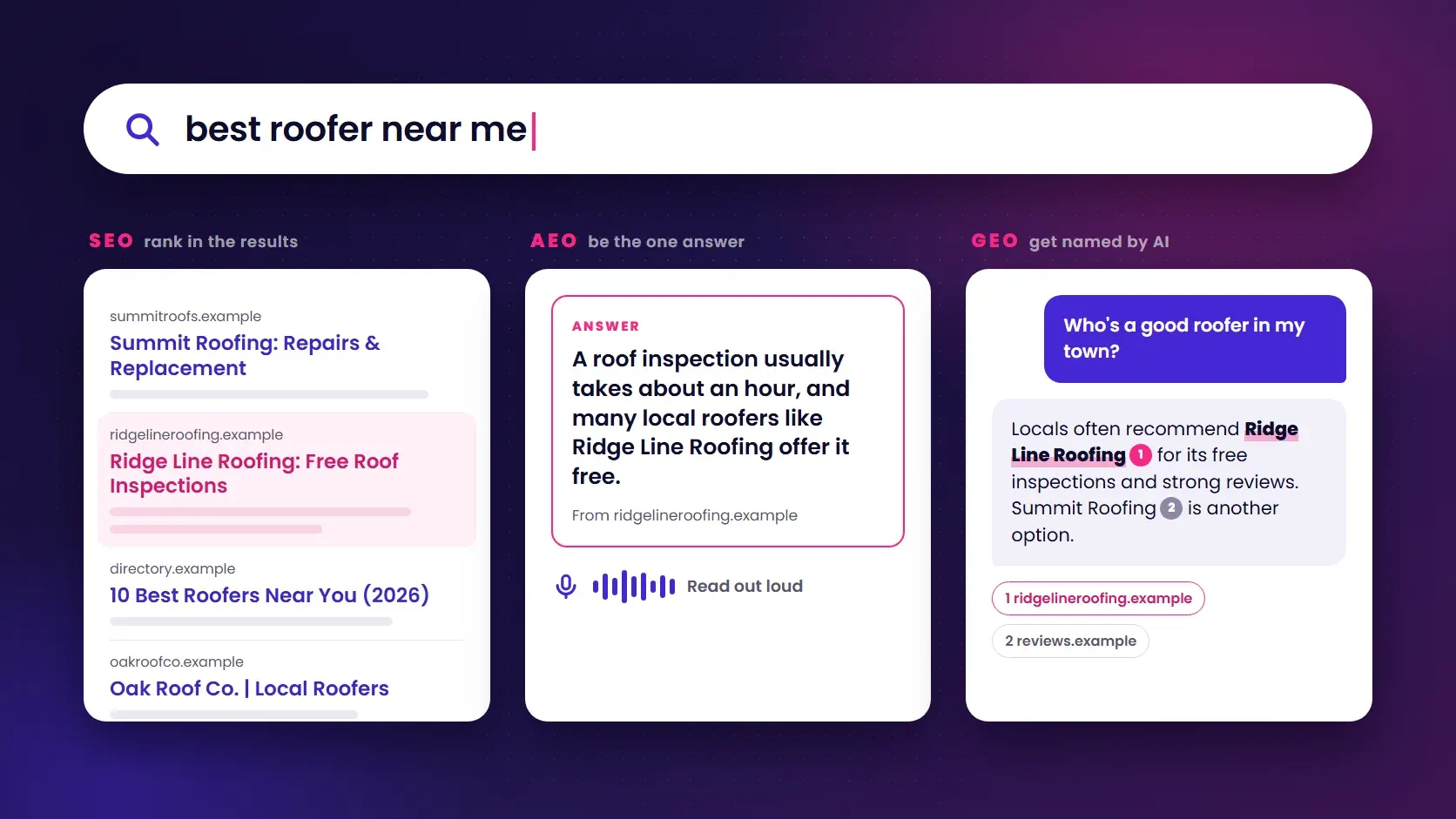
The short answer
SEO gets you found in search results. AEO (answer engine optimization) aims to be the answer that gets read out or shown at the top. GEO (generative engine optimization) aims to be cited by AI tools like ChatGPT and Google's AI Overviews. They're real goals, but mostly not new work: Google says optimizing for its AI features is still SEO and needs nothing special. For a local business, the work that helps all three is the same: clear answers on your site, a complete Google Business Profile, steady reviews and a name people search for.
If you own a small business, someone has probably already pitched you on AEO or GEO. Maybe it was an agency, maybe a LinkedIn post, maybe a webinar promising to “get you into ChatGPT.” The acronyms sound urgent and technical, and they usually come with a price tag.
So let’s answer the question plainly: what do SEO, AEO and GEO actually mean, how are they different, and is any of it more than marketing?
Short version: the goals are real, and AI search really is changing how people find businesses. But most of the work is the same work good SEO has always asked for. Google says so itself.
SEO, AEO and GEO in one sentence each
- SEO (search engine optimization): getting your pages to rank in the list of search results, so people click through to your site.
- AEO (answer engine optimization): getting your content picked as the answer: the featured snippet at the top of Google, the reply a voice assistant reads out loud, or the first lines of an AI summary.
- GEO (generative engine optimization): getting your business mentioned or cited when an AI tool, like ChatGPT, Perplexity, Gemini or Google’s AI Overviews, writes an answer from scratch.
You’ll also see AIO, LLMO and “AI SEO.” They all mean roughly the same thing as GEO. Different people, different labels, one idea.
How are they actually different?
The difference is in where you show up and what counts as winning:
| Compare | SEO | AEO | GEO |
|---|---|---|---|
| Where you show up | The list of links on a search results page | A single highlighted answer, spoken or shown | Inside an answer an AI tool writes |
| What winning looks like | A high ranking and a click | Being the one answer that gets used | Being named, quoted or linked as a source |
| Main places | Google, Bing | Featured snippets, voice assistants, AI summaries | ChatGPT, Perplexity, Gemini, Google AI Overviews and AI Mode |
| How you measure it | Rankings, clicks, traffic | Snippet wins, answer appearances | Mentions and citations, plus more people searching for you by name |
| How new is it? | Decades old | Took off with featured snippets and voice search | The name dates to a 2023 research paper |
That last row matters. GEO comes from an academic paper, “GEO: Generative Engine Optimization,” posted in late 2023 by researchers including a team from Princeton. They tested ways of rewriting web content and found some methods, like adding citations, quotes and statistics, could raise a source’s visibility in AI answers by up to 40% in their experiments. The authors also noted results varied a lot by topic. It’s a useful study, not a rulebook.
So is it all a marketing facade?
Partly. Here’s the honest breakdown.
What Google says. Google’s own guidance for site owners is blunt. On its page about AI features, it says there are “no additional requirements” to appear in AI Overviews or AI Mode, “nor other special optimizations necessary.” Its optimization guide goes further: from Google’s point of view, optimizing for generative AI search “is optimizing for the search experience, and thus still SEO.”
It also busts a few popular myths. You don’t need an llms.txt file (Google Search ignores them), special “AI text files” or a special type of schema markup to show up in its AI features.
What the “it’s different” camp says. Many SEO professionals argue AI tools pick sources differently than a ranking algorithm does. ChatGPT, for example, might mention a business because it’s described the same way across many trusted websites, not because one page ranks first. That’s a fair point. It just isn’t a reason to throw out the basics.
Where we land: the destination is new. The road is mostly the same. Most “GEO tactics” turn out to be good SEO with a new label: answer real questions clearly, show proof, keep your facts consistent everywhere and earn mentions on sites people trust.
What has actually changed
The acronyms are mostly noise. The shift underneath them isn’t:
- Fewer clicks. In a 2025 Pew Research Center study of real Google searches, people clicked a regular search result in 8% of visits when an AI summary appeared, compared with 15% when one didn’t. Clicks on the links inside the AI summary itself happened in just 1% of visits.
- People ask AI for local recommendations. BrightLocal’s 2026 Local Consumer Review Survey found the use of ChatGPT and other AI tools for local business recommendations rose from 6% to 45% in a year.
Put those together and the goal shifts a little. It’s not only “get the click.” It’s “be the business the answer names, and be easy to find when someone looks you up.”
What a local business should actually do
Here’s the good news: one short list helps you with SEO, AEO and GEO at the same time.
1. Answer real questions on your site
Write down the questions customers ask you on the phone, like what it costs, how long it takes or whether you serve their town, and answer them on your website in plain words. Put the answer in the first sentence or two, then explain. That’s what search results, voice assistants and AI tools all pull from. (If you’re not sure what your customers actually ask, start with a customer avatar.)
2. Keep your Google Business Profile complete
Google’s own AI guidance tells local businesses to keep their Business Profile information current. Hours, services, service area, photos and your phone number should be complete and correct. For “near me” searches, your profile often matters more than your website.
3. Keep your facts the same everywhere
Your business name, address, phone number and services should match on your website, your Google Business Profile, Facebook, Yelp and every directory you’re listed in. AI tools build their picture of your business from many sources. Conflicting details make that picture blurry.
4. Earn reviews, steadily
Reviews are proof to people and a strong signal to search and AI tools. Make asking a habit, not a once-a-year push. A printed card with a QR code that goes straight to your review page makes it easy: make one with our free Google review card maker.
5. Get mentioned around town
Local news, chamber of commerce listings, sponsorships, supplier pages and community groups all count. Every place your business is described is another source AI tools can learn from.
6. Make people search for you by name
When fewer people click through from search results, the businesses that win are the ones people already know. Yard signs on jobs, door hangers on the street, cards in hand and branded trucks all send people to search for you by name. That’s a search you can’t lose to a competitor. Our 10-Around playbook shows how to turn one job into a street full of those searches.
What you can skip
- llms.txt files, at least for Google. Google Search ignores them. They won’t hurt, but they won’t help you there.
- “AI-only” schema or special markup. Normal structured data is fine. There’s no secret AI version.
- Separate content “for the robots.” Write for customers. The tools are trying to find what customers would find useful.
- Anyone selling guaranteed AI placement.
The bottom line
SEO, AEO and GEO aren’t three separate jobs. They’re three names for one goal at different stops on the same road: be the clearest, most trusted answer for your kind of business in your area. The acronyms are partly marketing. The shift in how people search is not.
For a local business, the playbook is refreshingly old-fashioned: answer questions clearly, keep your profile and facts tidy, earn reviews and make your name show up around town so people come looking for you. If you’re working the neighborhoods, the Local Canvas Pro kit puts matching yard signs, door hangers and business cards to work on that last part.
Questions people ask
What is the difference between SEO, AEO and GEO?
They describe different goals. SEO (search engine optimization) is about ranking in the list of search results so people click through to your site. AEO (answer engine optimization) is about being the direct answer: a featured snippet, a voice assistant reply or the top of an AI summary. GEO (generative engine optimization) is about being mentioned or cited when an AI tool like ChatGPT, Perplexity or Google's AI Overviews writes an answer.
Is GEO just SEO with a new name?
Mostly, yes. Google's own guidance says that optimizing for its generative AI features is still SEO and that no special optimization is needed. Some practitioners argue AI tools pick sources differently enough to deserve their own name. The honest middle ground: the goal is new, the work is largely the same.
Do I need an llms.txt file or special schema for AI search?
Not for Google. Google says you don't need new machine-readable files, AI text files or special schema markup to appear in its AI features, and that Google Search ignores llms.txt files. Regular structured data is still worth having for rich results.
Is AEO the same as voice search optimization?
It grew out of it. AEO started with featured snippets and voice assistants, which read one answer out loud. Today the term also covers AI summaries. The core idea hasn't changed: answer the question clearly, near the top, in plain words.
Should a small business hire a GEO or AEO agency?
Be careful. Ask what they'll do that isn't normal SEO. If the answer is clear content, technical health, reviews, your Business Profile and mentions on other trusted sites, that's good SEO under a new label, so judge it by price and results. If they promise guaranteed placement in ChatGPT or Google's AI Overviews, walk away: nobody controls that.
Does AI search still send traffic to websites?
Less than regular results do. In a 2025 Pew Research Center study, Google users clicked a search result in 8% of visits when an AI summary appeared, compared with 15% when one didn't. That makes being named in the answer, and being easy to find by name afterward, more important.
Sources
- AI features and your website (Google Search Central)
- Optimizing your website for generative AI features on Google Search (Google Search Central)
- GEO: Generative Engine Optimization (Aggarwal et al., arXiv / KDD 2024)
- Google users are less likely to click on links when an AI summary appears in the results (Pew Research Center, 2025)
- Local Consumer Review Survey 2026 (BrightLocal)