Local Marketing 8 min read
Yard Sign Marketing: 25 Ideas, the Best Spots and Proof They Work
Do yard signs work? What the research says, the highest-traffic spots to put them, and 25 ideas local businesses use to turn a cheap sign into real calls.
The short answer
Yes, yard signs work, and they're one of the cheapest ads a local business can buy. In a randomized study, signs raised candidates' vote share by about 1.7 points, and the effect spilled into neighboring areas. The best results come from signs on customers' lawns and busy corners, with one simple message and a way to track calls.
A yard sign is the hardest-working ad most local businesses own. It costs a few dollars, it works 24 hours a day, and it stands in exactly the neighborhood you want to win, often on the lawn of someone who just hired you.
Here’s the proof that yard signs work, the spots where they get seen most, and 25 ideas you can use this month.
Do yard signs really work?
They do, and there’s better evidence than you might expect.
The best-known study comes from politics, where yard signs are everywhere. Political scientists from Columbia University and other schools ran four randomized field experiments, planting signs in randomly chosen voting precincts and comparing the results to precincts without them. That’s the same method used to test medicine, and it’s rare for marketing.
+1.7 points
Average increase in vote share where lawn signs were placed, pooled across four randomized experiments
Source: Green, Krasno, Coppock et al., Electoral Studies, 2016
Three findings matter for any business:
- Signs moved people. Pooled across all four experiments, signs raised the advertised candidate’s vote share by about 1.7 percentage points. The researchers put that on par with direct mail.
- The effect spread to the next neighborhood over. Precincts next to the ones with signs saw a lift of about 1.5 points, with no signs of their own. People drive through more than one neighborhood.
- It was cheap. The authors estimated the signs cost about $3.18 for every vote they moved.
In an election, a 1.7-point lift can decide the race. For a local business, the takeaway is simpler: people really do notice yard signs, and seeing your name around town changes what they do.
Contractors have seen it firsthand. The trade magazine JLC (Journal of Light Construction) has reported several examples:
- Marrokal Design & Remodeling in San Diego celebrated its 30th anniversary by placing about 40 signs per neighborhood in past clients’ yards, six weeks at a time, across 14 communities. The campaign brought in 40 leads and 12 projects.
- Mark IV Builders in Bethesda, Maryland, asked past clients to host a 25th-anniversary sign for 25 days. 48 signs went up, and one of the two leads became a $10,000 job.
- Brothers That Just Do Gutters in Poughkeepsie, New York, credited 10 jobs in a year to its yard signs.
Where do yard signs get seen the most?
A sign only works if people see it, and people read signs when they’re moving slowly or stopped. Look for:
- Corner lots at stop signs and four-way stops. Every driver stops, looks both ways and reads your sign. Corners are also seen from two streets.
- Homes on the street that feeds a neighborhood. If there’s one main way in and out, everyone who lives there drives past it twice a day.
- School pickup and drop-off routes. Slow lines of parents, every weekday, for months.
- Near traffic lights and busy intersections. Red lights give drivers time to read.
- Cul-de-sacs. Less traffic, but every neighbor on the circle sees it every day, and they’re your best leads.
- Across from parks, pools and ball fields. Lots of foot traffic, and people on foot read everything.
- Your own storefront, office or shop. The sign that’s easiest to get permission for is the one on your own property.
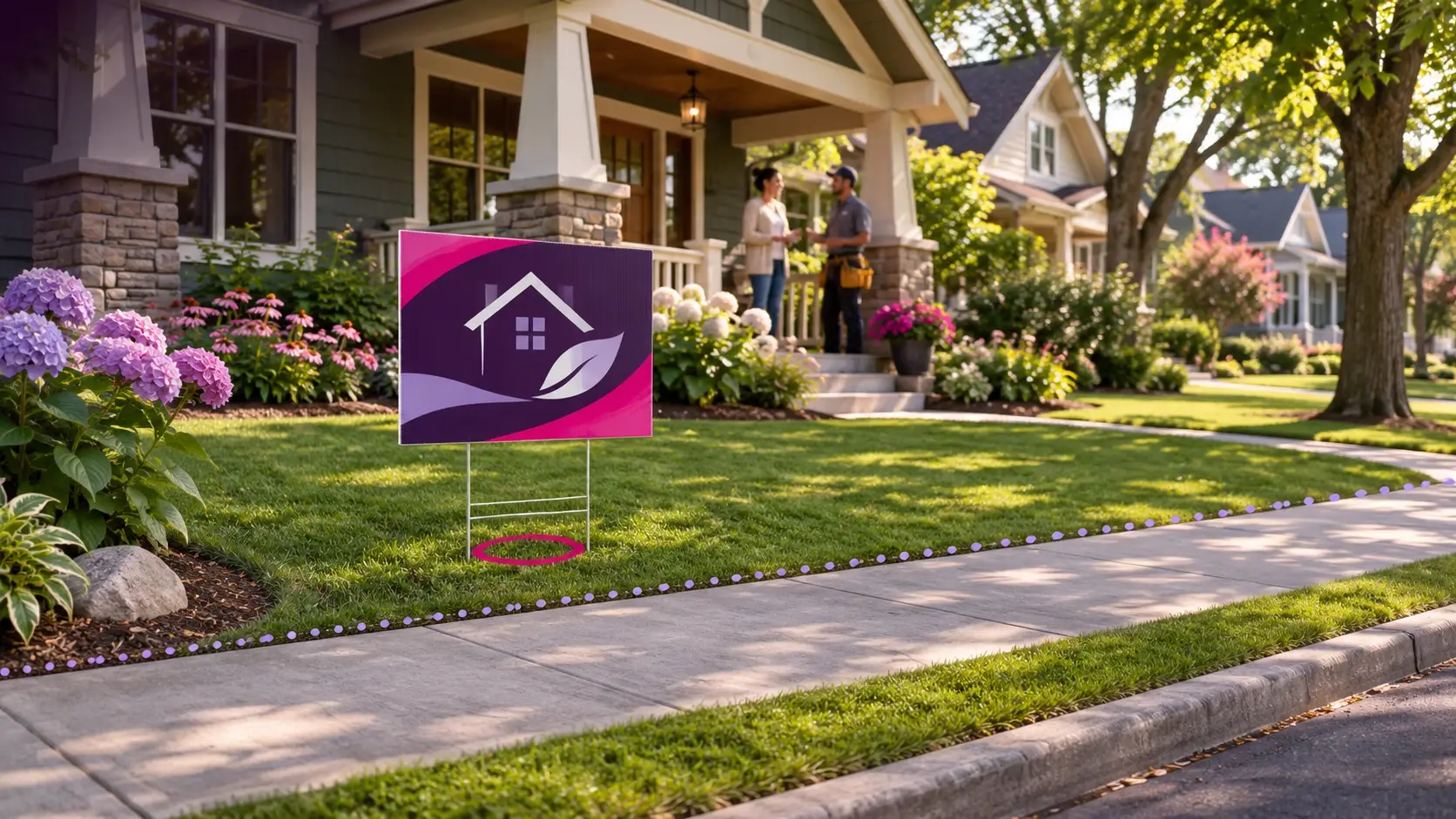
All of these are private property, used with the owner’s permission. The grass strip by the road usually isn’t the homeowner’s to offer: it’s often public right-of-way, and signs there get pulled. For the details, see our guide to where you can put yard signs.
25 yard sign ideas that bring in calls
On the job
1. Put the sign up on day one, not when you finish. The work in progress is the show. Neighbors watch the dumpster, the crew and the truck all week, and the sign tells them who it is.
2. Ask for the sign when the contract is signed. Make it part of your paperwork (“May we place a sign in your yard during the job?”). Asked up front, most customers say yes. Some businesses offer a small thank-you for it.
3. Swap in a “Just finished” sign at the end. When the work is done, change the message to “Another happy customer” or “Just finished by [your company]” and leave it up for the agreed time. The finished job is the best ad on the street.
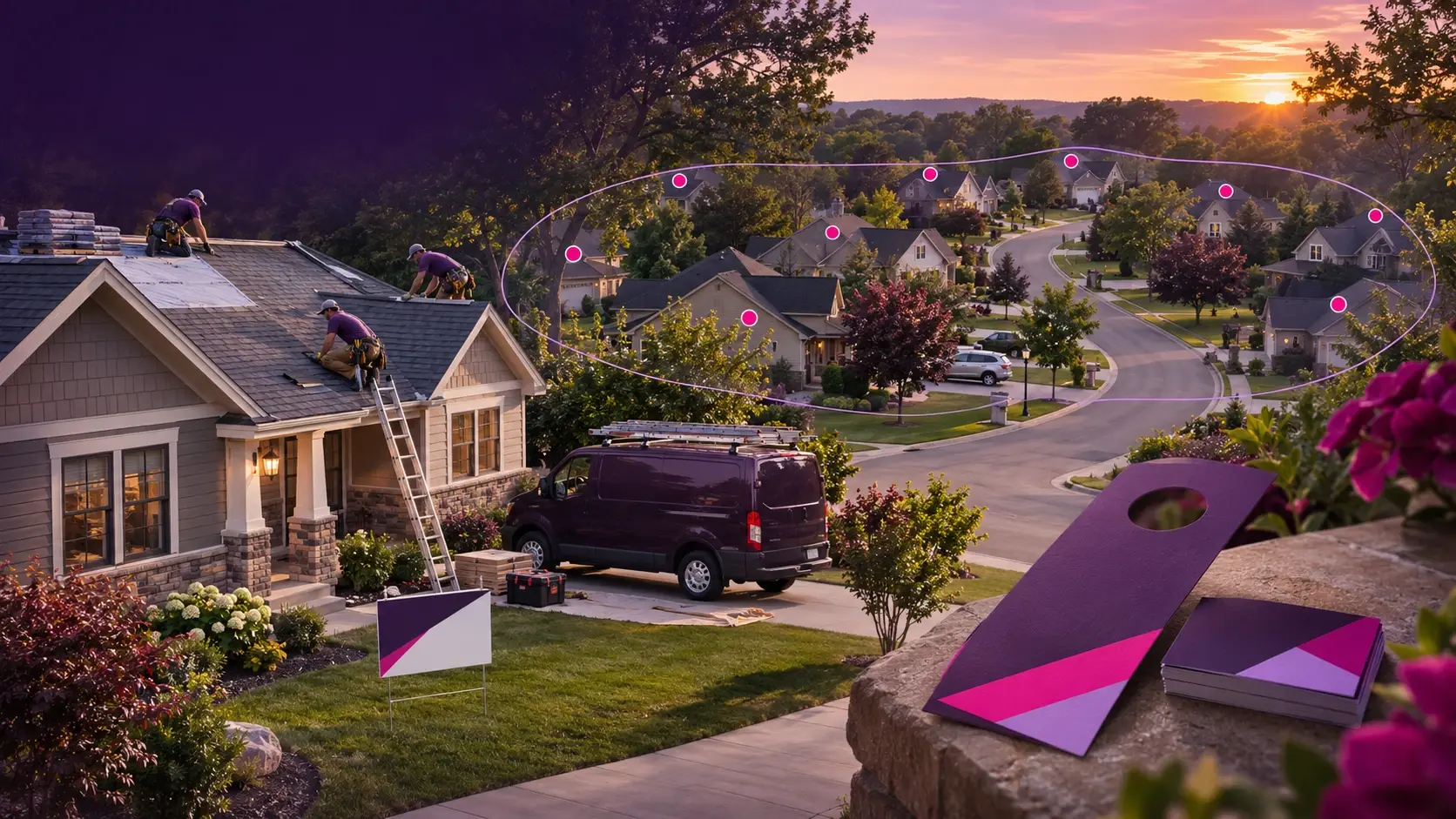
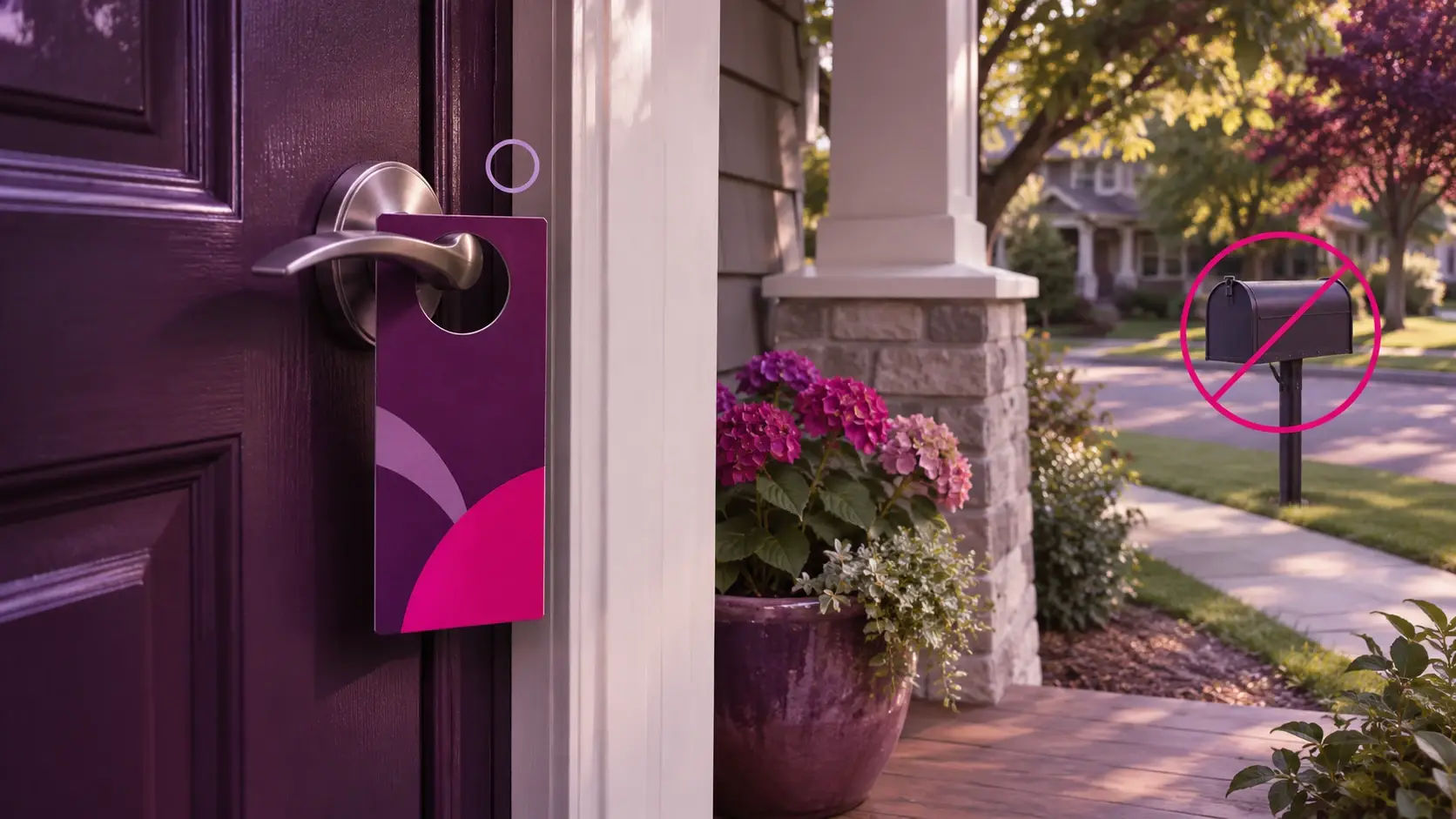
4. Pair the sign with door hangers. The sign makes people curious, and a door hanger on the homes around the job answers the question. That’s the 10-Around playbook.
5. On a corner lot, use two signs. One facing each street. You’ll double your audience for a few extra dollars.
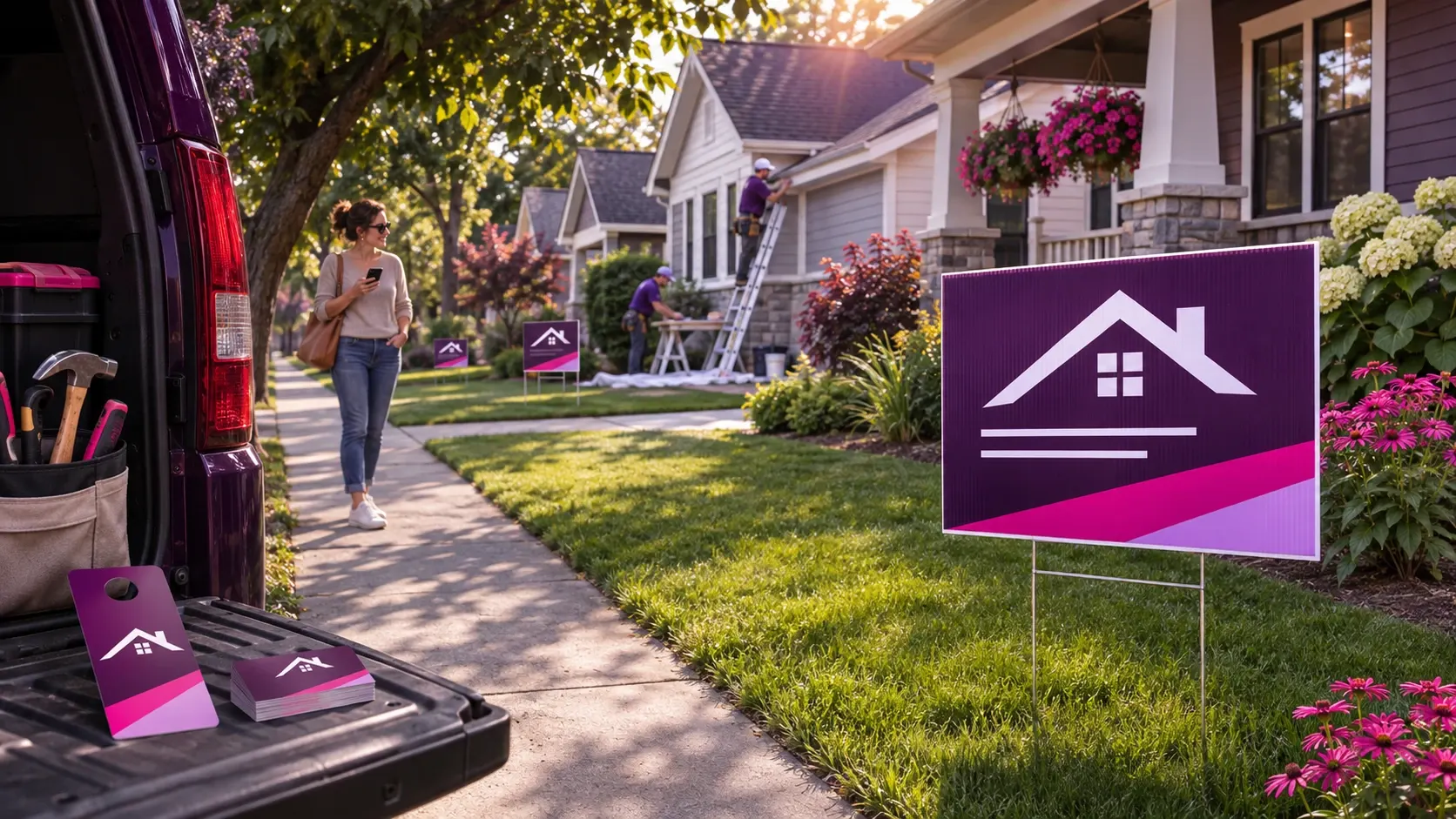
6. Keep cards in the truck. Signs make neighbors walk over and ask. Have business cards ready for every one of them.
With past customers
7. Run an anniversary sign campaign. Like Marrokal and Mark IV, ask past clients to host a celebration sign for a few weeks. It’s a reason to call them, a thank-you, and a neighborhood ad all at once.
8. Call, don’t email. Mark IV found that emailing past clients got no replies, while personal calls worked. Five minutes on the phone gets the yes.
9. Map your customers on busy streets. Look through your past jobs for homes on corners, main roads and school routes. Those customers are your best sign hosts. Ask them first.
10. Host a jobsite open house. JLC reported that Southwest Exteriors in San Antonio set out as many as 50 signs, some in past customers’ yards a week ahead, to draw neighbors to a Saturday jobsite breakfast. Signs bring people to an event, and the event brings in jobs.
11. Make signs easy to bring back. Energy Swing Windows in Pennsylvania paid customers $5 to return their signs, and 40% to 50% did. Reused signs cut costs, and a returned sign is one you can place again.
Around your community
12. Use your own property. Your storefront, office lawn or shop entrance is the one spot you never have to ask about.
13. Team up with a business next door to yours. A landscaper and a pool company, a realtor and a home inspector: put each other’s signs on your properties, with permission, and share each other’s customers.
14. Sponsor a youth team or school event. Many leagues and boosters offer sponsor signs at the field. Parents see them every game, all season.
15. Bring signs to every booth. Farmers markets, home shows and festivals. A yard sign is a cheap, sturdy booth banner that people see from across the lot.
16. Advertise from home, if your town allows it. Home-based businesses can often put a small sign at home. Check your town’s home business rules first.
Message and design
17. Three things, and only three. Your name, what you do and how to reach you. Drivers have a few seconds. “Smith Roofing · Roof Repair & Replacement · 555-0142” beats a paragraph every time.
18. Do the drive-by test. Before you print a hundred, put one in a yard and drive past at normal speed. If you can’t read the phone number, make it bigger and cut something else.
19. Choose the right size for the spot. 18 by 24 inches for signs meant to be read from the road. 12 by 18 inches for lawns near the sidewalk, walkways and doorsteps. We print both: see yard signs.
20. Use a QR code only if it’s big enough. A QR code is great for people walking by and useless from a moving car. If you add one, make it large, put it near the bottom and point it somewhere useful, like your reviews or a quote form. You can make one free with our QR code generator.
21. Match your sign to the rest of your marketing. Same colors, same logo and same phone number on your signs, door hangers and cards. When neighbors see the sign, then get the door hanger, they should know right away it’s the same company.
22. Put a season on it. “Now booking spring cleanups” or “Ask about our fall special” gives people a reason to call now instead of someday. Rotate the message each season.
23. Add social proof, if it’s true. “Ask your neighbor about us” or “Trusted on this street since 2015” turns the sign from an ad into a recommendation.
Measure it
24. Give signs their own phone number or web address. A call-tracking number, a short web address or a QR code used only on signs tells you exactly how many calls the signs bring in.
25. Ask every caller, and count your signs. “How did you hear about us?” on every first call, written down. Count signs out and back in, too. After a season you’ll know what each sign earns, which is usually much more than it cost.
How yard signs fit with the rest of your marketing
A yard sign rarely closes the job by itself. It’s the thing that makes people notice you, and it works best with a follow-up:
| Piece | Its job |
|---|---|
| Yard sign | Gets noticed: tells the whole street who’s working here |
| Door hanger | Explains: what you do, your offer and how to reach you |
| Business card | Gets kept: for the neighbor who walks over to ask |
| Postcard | Covers the wider neighborhood by mail, without walking it |
Signs and door hangers that match make your business look established, as if you’re working everywhere, because you are.
The bottom line
Yard signs work: the research says so, contractors who track them say so, and you’ve probably called a company because you saw its sign. Put them where traffic slows down, keep the message to three things, get one into every customer’s yard and track the calls. For a few dollars a sign, there are few better ways to win a neighborhood.
Questions people ask
Do yard signs actually work for businesses?
Yes, especially for local service businesses. A peer-reviewed randomized study found lawn signs raised candidates' vote shares by about 1.7 percentage points, a persuasion effect the authors put on par with direct mail. Contractors report real results too: one remodeler's anniversary sign campaign produced 40 leads and 12 projects.
Where should I put yard signs to get the most attention?
Where people drive slowly or stop: corner lots at stop signs, homes near school pickup routes, streets that feed into a neighborhood, and your customers' yards while you're working there. Always on private property, with the owner's permission.
What should a yard sign say?
Three things: your business name, what you do and how to reach you. If a driver can't read it in about five seconds from the street, it has too much on it.
What size yard sign should I get?
18 by 24 inches is the classic size for signs meant to be read from a car. 12 by 18 inches works for smaller lawns, walkways and spots close to the sidewalk.
How do I know if my yard signs are working?
Give the signs their own way to respond: a tracking phone number, a short web address or a QR code used only on signs. Then ask every new caller how they heard about you and write it down.
Can I put yard signs on the side of the road?
Usually not. The strip along the road is usually public right-of-way, and most cities and states remove business signs placed there and can fine you. Our guide to where you can put yard signs covers the rules and the best legal spots.
Sources
- Green, Krasno, Coppock et al., The Effects of Lawn Signs on Vote Outcomes: Results from Four Randomized Field Experiments, Electoral Studies 41 (2016)
- Anniversary Signs Both Celebrate and Bring in Leads, JLC (Journal of Light Construction), June 2013
- Integrate Job Signs Into Your Overall Marketing Plan, JLC (Journal of Light Construction), September 2012