Local Marketing 8 min read
Customer Avatars: What They Are, How They Differ From an ICP and How to Use One
What a customer avatar is, how it differs from an ICP and a buyer persona, and how to use one to write ads, flyers and door hangers. Local business examples.
The short answer
A customer avatar is a one-page sketch of one specific, real-feeling person who is your best customer: what they want, what worries them, what they say and where they'll see you. An ICP tells you which customers to go after; the avatar tells you what to say to them. Write every ad, flyer and door hanger to that one person.
Most ads that don’t work fail for the same reason: they were written for “everyone in the area.” Everyone is nobody. When you try to talk to everyone, you end up saying safe, general things (“quality service, competitive prices”) that nobody remembers.
A customer avatar fixes that. It’s a simple, one-page picture of the one person you most want to hear from. Once you know who that person is, writing the ad gets easier, because you’re no longer writing to a crowd. You’re writing to someone.
What is a customer avatar?
A customer avatar is a short, specific description of one imaginary person who stands for your best customers. It has a name, an age and a situation, but the important part is what’s going on in their head:
- What they want
- What’s frustrating them right now
- What they worry about before they hire someone or buy something
- The exact words they use to describe the problem
- Where they’ll actually see your marketing
It’s “imaginary” only in the sense that it isn’t one real customer. A good avatar is built from your real ones: the calls you get, the questions people ask, the reviews they leave and the jobs you love doing.
Customer avatar vs. ICP vs. buyer persona
These three terms get mixed up constantly, and honestly, marketers don’t all agree on where one stops and the next starts. HubSpot’s own article on the question opens by arguing they’re not really different at all. Here’s the practical way to think about them:
| Compare | Ideal customer profile (ICP) | Buyer persona | Customer avatar |
|---|---|---|---|
| Describes | The kind of customer worth going after | A typical buyer within that group | One vivid, specific person |
| Built from | Facts you can filter on: location, type of home or business, size, budget | Research and interviews | Real customers, plus your gut for how they feel |
| Answers | “Who should we target?” | “Who are we selling to and how do they decide?” | “What do I say so they call?” |
| Best for | Choosing areas, lists and where to spend | Sales, service and company-wide planning | Ads, headlines, flyers, door hangers and scripts |
| Example | Owner-occupied single-family homes, 15 to 30 years old, in three ZIP codes | Homeowners 40 to 65 replacing original systems | “Carol, 58, worried her roofer won’t show up” |
The ICP came out of business-to-business sales, where it describes the kind of company worth chasing. Personas came out of product design: software designer Alan Cooper popularized them in the late 1990s as a way to design for a specific person instead of a vague “user.” The customer avatar is the copywriter’s version: less about data, more about getting inside one person’s head.
The short version: the ICP picks the street. The avatar writes the door hanger.
Why a customer avatar makes your marketing better
People notice when marketing is written for them. In McKinsey’s research on personalization, 71% of consumers said they expect companies to deliver personalized interactions, and 76% said they get frustrated when that doesn’t happen.
A small business usually can’t personalize every message the way a big brand with a data team can. But an avatar gets you most of the way there, because every ad you write starts from the same question: would Carol care about this? That changes things fast:
- Headlines get specific. “Roof leaking? We’ll be there this week” beats “Quality roofing solutions.”
- You know which objection to answer. If your avatar’s biggest worry is that contractors don’t show up, your flyer says “We show up when we say we will” and backs it up with reviews.
- You stop wasting space. Anything Carol wouldn’t care about comes off the page.
- Your look and tone get consistent. Your yard signs, truck, website and door hangers all sound like they’re talking to the same person, because they are.
- You know where to show up. If your avatar never checks social media but walks her dog every evening, a door hanger or yard sign may reach her better than a post.
How to build a customer avatar in 30 minutes
You don’t need a research budget. You need your phone, your reviews and half an hour.
1. Pick your best customer, not your average one
Think of the jobs or sales you’d love to repeat: good margin, easy to work with, paid on time, sent you referrals. Start there. Keap’s guide suggests starting with the market that brings you the most profit, and it’s good advice: your avatar should pull in more of your best customers, not more of everyone.
2. Gather the real words
Look through your Google reviews, your texts and emails, and your notes from phone calls. Write down the exact phrases customers use. “I was tired of chasing contractors who never called back” is gold. It’s a ready-made headline in your customer’s own voice.
3. Fill in the one-page sketch
Answer these questions about one person:
- Name, age and situation. Give them a name you’ll remember. (“Carol, 58, owns a 1990s two-story, kids moved out.”)
- What they want. The real goal behind the purchase. Not “a new roof,” but “to stop worrying every time it rains.”
- What frustrates them. The problem they’re living with right now.
- What they worry about before buying. Price, trust, mess, being upsold, getting stuck with a no-show.
- What makes them say yes. Reviews from neighbors, a clear price, a guarantee, a local name.
- How they talk. Two or three phrases straight from step 2.
- Where they’ll see you. Their mailbox, their front door, their street, Google, Facebook groups, the hardware store.
- A one-line quote. Something they might say to a friend about the problem. DigitalMarketer’s well-known avatar worksheet includes this field, and it’s one of the most useful lines on the page.
4. Write a negative avatar too
Keap also recommends describing the customer you don’t want. Maybe it’s the shopper who only wants the lowest price and will haggle over every line, or the job that’s too small to be worth the drive. Knowing who you’re not for keeps your marketing from drifting toward them.
5. Put it where you’ll see it
Print it, pin it above your desk, or save it as the first note on your phone. The avatar only works if you look at it every time you write something.
Customer avatar examples for local businesses
Here are three avatars to show what a finished one looks like. Use them as a starting point, then rewrite them with what your own customers say.
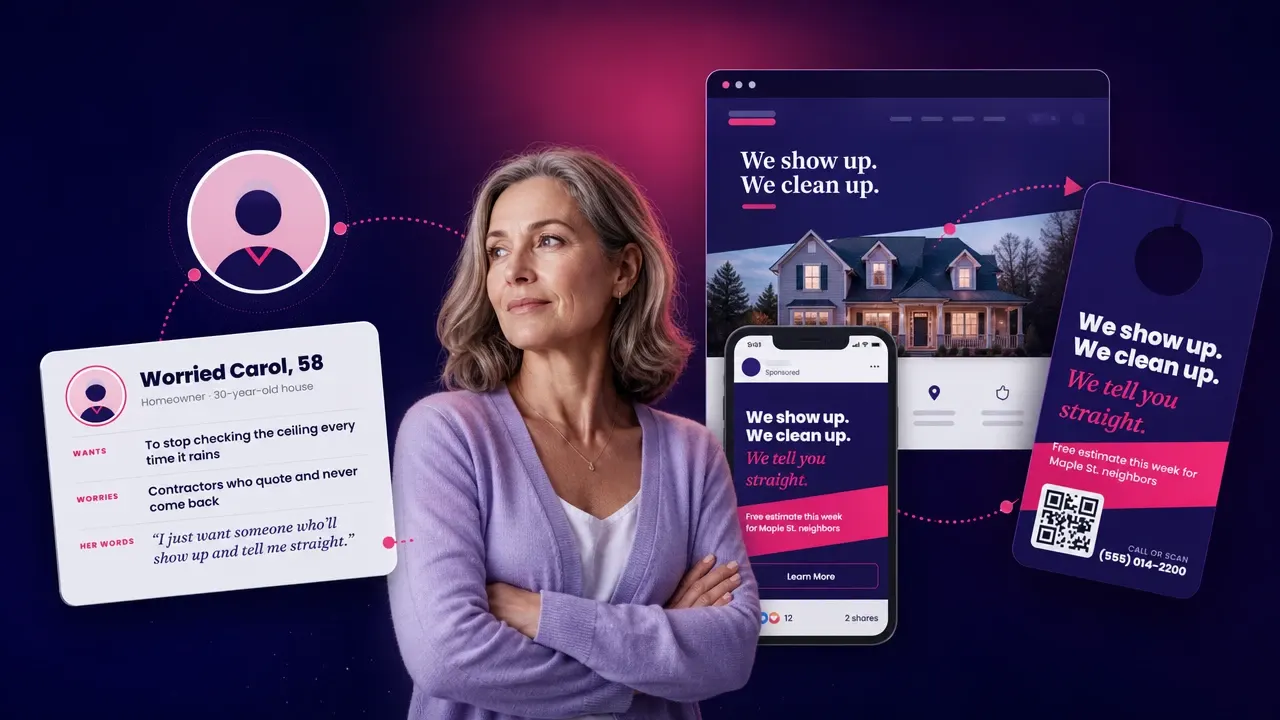
Roofing: “Worried Carol”
- Who: 58, owns a 30-year-old house she plans to stay in, retired teacher.
- Wants: To know the roof is handled so she can stop checking the ceiling after every storm.
- Frustrated by: Two contractors who gave quotes and then disappeared.
- Worries about: Getting overcharged, strangers on the property, a mess in the yard.
- Says yes because of: Neighbors’ reviews, a clear written estimate, a crew that cleans up.
- Her words: “I just want someone who’ll show up and tell me straight.”
- Sees you on: Her front door, her neighbor’s yard, Google.
Door hanger headline written for Carol: “We’re the crew working on your neighbor’s roof. We show up, we clean up, and the estimate is free.” (That’s the 10-Around playbook, written for one person.)
Restaurant: “Lunch-Break Marcus”
- Who: 34, works at an office park two miles away, 45 minutes for lunch.
- Wants: Something good that’s fast and doesn’t feel like fast food.
- Frustrated by: Long lines and “15 minutes” that turns into 30.
- Says yes because of: Ordering ahead, a lunch special, a place his coworkers already like.
- His words: “I’ve got 45 minutes, tops.”
- Sees you on: A flyer in the break room, a table tent, his phone.
Flyer headline written for Marcus: “Order by 11:45, eat by noon.” With a QR code that opens the order page, so he doesn’t have to type anything.
Landscaping: “Weekend-Back Brian”
- Who: 42, two kids in travel sports, works long weeks.
- Wants: His Saturdays back, and a yard he isn’t embarrassed by.
- Worries about: Being locked into a contract, crews that skip weeks.
- Says yes because of: A simple monthly price, no contract, before-and-after photos from his street.
- His words: “I’m done spending my whole Saturday on the lawn.”
- Sees you on: His mailbox, yard signs in the neighborhood, Nextdoor.
Postcard headline written for Brian: “Get your Saturdays back. Weekly mowing, one monthly price, no contract.”
How to use your avatar to write your ads and print
Once the avatar exists, use it as a checklist every time you make something:
- Headline = their problem or their goal, in their words. Pull it straight from the “their words” line.
- First line answers their biggest worry. If it’s trust, show reviews or a guarantee. If it’s price, show a price or a free estimate.
- One offer, made for them. Carol gets a free inspection. Marcus gets a lunch special. Brian gets no contract.
- Pictures that look like their life. Carol’s style of house, Marcus’s lunch, Brian’s backyard.
- One easy next step. A big phone number, or a QR code that opens exactly the page they need.
- Put it where they’ll actually see it. Door hangers and yard signs for homeowners on a street you’re working; flyers and table tents where your lunch crowd already is (and a review card on every table); postcards for whole neighborhoods.
And track it. Give each piece its own phone number or QR code link so you can see which avatar, and which message, actually brings in calls. The results will tell you whether your avatar is right.
Common customer avatar mistakes
- Making it about demographics only. “Women 35 to 65” tells you nothing about what to say. The feelings and words are what make an avatar useful.
- Describing who you wish bought from you. Build it from real customers, not a fantasy.
- Creating ten of them. Start with one. Add another only when a group truly buys for different reasons.
- Building it and filing it away. If you don’t look at it while writing, it won’t change anything.
- Never updating it. Your best customers change as your business grows. Revisit it when you add a service or move into a new area.
The bottom line
An ICP tells you who to go after. A customer avatar tells you what to say when you get there. Spend 30 minutes describing the one customer you’d love more of, in their own words, and then write every headline, flyer and door hanger to that person. Your marketing will sound less like an ad and more like you understand them, which is exactly why people call.
Questions people ask
What is a customer avatar?
A short, specific description of one imaginary person who stands for your best customers. It covers who they are, but mostly what they want, what frustrates them, what they worry about before buying and the words they use. You write your marketing to that one person.
What's the difference between a customer avatar and an ICP?
An ideal customer profile (ICP) describes the kind of customer worth going after, usually with facts you can filter on: type of business or home, size, location, budget. A customer avatar describes the person inside that profile: their feelings, fears and words. The ICP picks the target; the avatar writes the message.
Is a customer avatar the same as a buyer persona?
Mostly, yes. The terms overlap and different marketers use them differently. In practice, 'buyer persona' often means a research-backed profile used across a company, while 'customer avatar' usually means a vivid, one-person sketch built for writing ads and copy.
How many customer avatars should a small business have?
Start with one: the customer you'd clone if you could. Add a second only when you have a clearly different group that buys for different reasons, such as homeowners and property managers. Each avatar gets its own ads.
Is a customer avatar the same as an AI avatar?
No. An AI avatar is a computer-generated person who appears in videos or chats. A customer avatar is a planning tool: a written picture of your ideal customer. This guide is about the second one.
How often should I update my customer avatar?
Look at it whenever you launch a new service, enter a new area or notice your best jobs are coming from a different kind of customer. A quick review once or twice a year keeps it honest.